If your nurse station runs a Zebra® medical printer, “which wristband looks good” is the wrong shopping question. The real one is narrower: is this cartridge built for your printer, in your patient group’s size, with documentation your procurement team can actually read?
This guide walks through the four checks that matter for compatible direct thermal patient wristbands — and where most replacement orders go wrong.
Check 1 — Confirm the printer model first
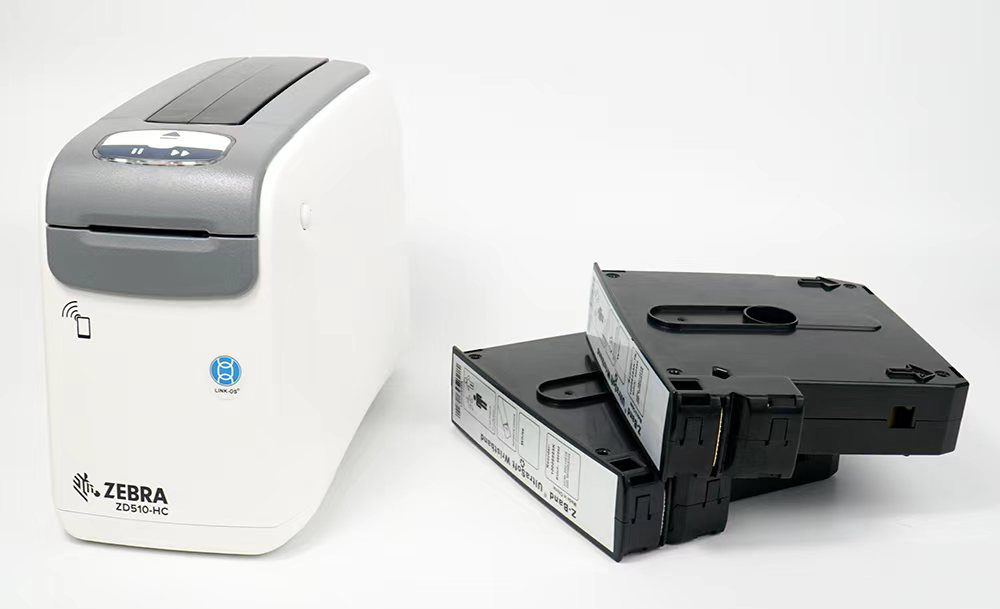
Compatible is a two-way street. A wristband line that fits one Zebra printer does not automatically fit another, even within the same product family. For the cartridge line covered here, confirmed compatibility covers exactly two models:
- Zebra HC100
- Zebra ZD510-HC
No other Zebra printer is listed as confirmed. We do not claim “fits all Zebra printers,” and you should treat any supplier that does the same way.
| Check | What to verify | Why it matters |
|---|---|---|
| Printer model | HC100 or ZD510-HC | Media width, sensor type and cartridge specs differ across the ZD range |
| Media sensor setting | Mark (reflective) for ZD510-HC; auto-calibrated cartridge recognition for HC100 | Wrong setting = skipped labels, wasted wristbands |
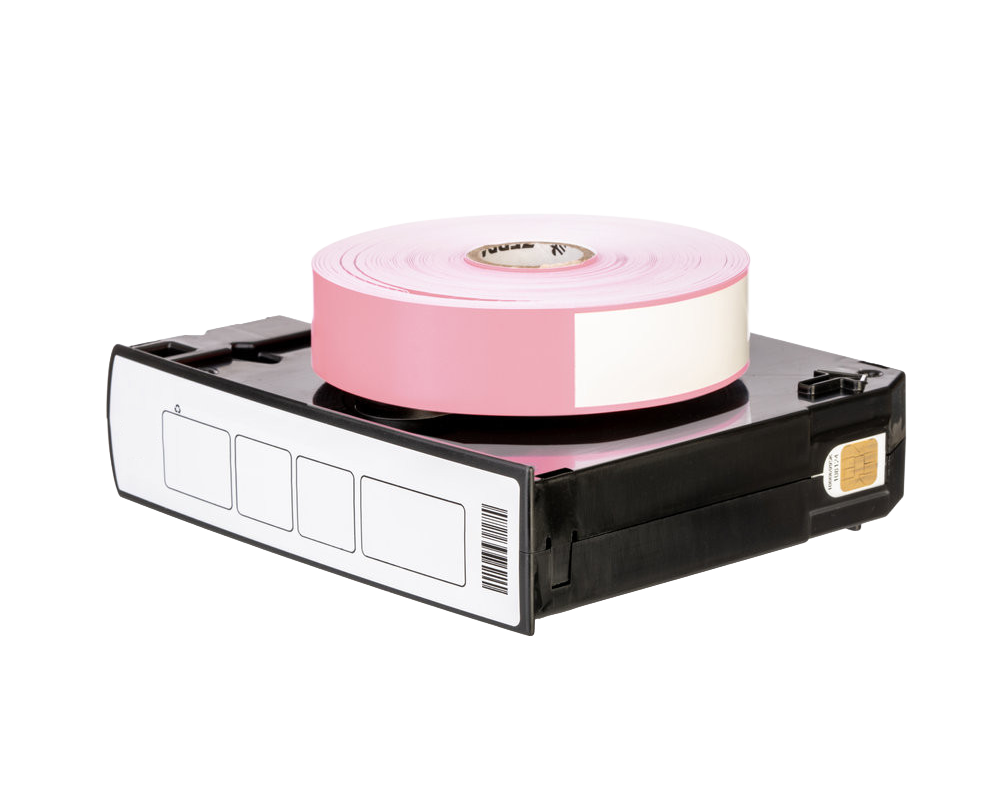
| Cartridge form factor | Wristbands must arrive in a cartridge, not a loose roll | Both printers take cartridge media; a loose roll cannot be loaded |
| Black mark on wristband back | Wristbands ship with a black mark on the reverse side | The printer locates each band by this mark; missing or misaligned marks cause feed errors |
Before you ask for a quote, look at the printer’s model label — usually on the back or bottom. If you cannot find it, take a photo and send it to the supplier. Two minutes of that saves a six-week reorder cycle.
Check 2 — Understand “cartridge” before you compare prices
Here is the part most generic listings skip.
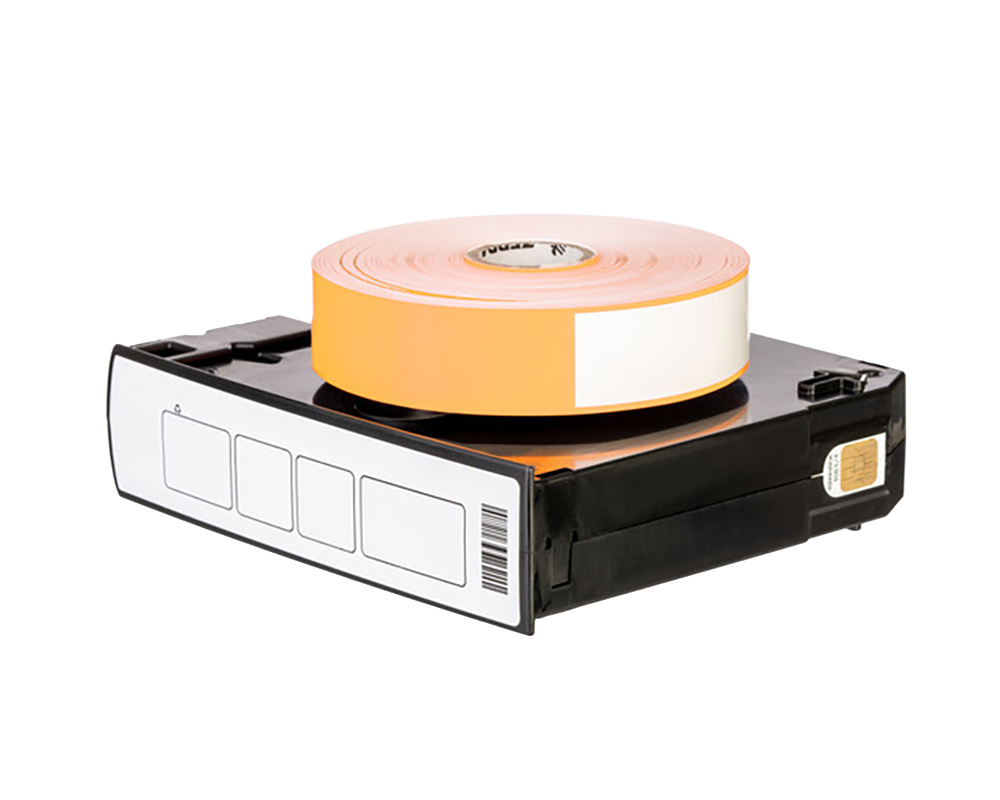
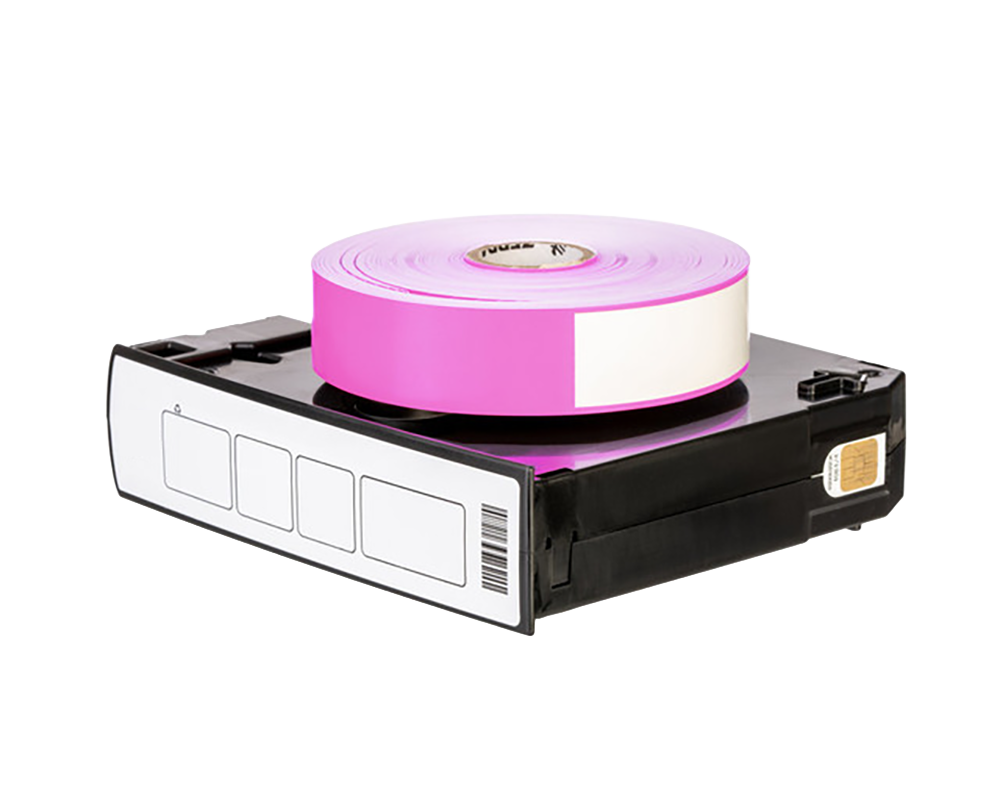
Both the HC100 and the ZD510-HC are cartridge-based printers. The wristband roll sits inside a plastic cartridge that clicks into the printer. Insert the cartridge, and the HC100 reads the embedded smart card, sets the media width, and runs automatic calibration. No manual length entry.
What this means for procurement:
- You are not buying a loose roll that fits into a universal spindle. You are buying a cartridge that mounts into a specific printer.
- If a supplier quotes you “compatible Zebra wristbands” without specifying cartridge form, ask explicitly. A roll-only product cannot be loaded into an HC100 or ZD510-HC.
- Cartridge count, not roll count, drives your box math. One roll equals one cartridge.
That single fact explains why hospital reorders tend to go smoothly once the first cartridge is approved — the calibration step that causes most teething trouble is built into the cartridge swap itself.
Check 3 — Match the size to the patient group
Once the printer is confirmed, the next decision is band dimensions. The confirmed cartridge catalog maps cleanly to patient groups:
| Patient group | Typical size (W × L) | Example cartridge |
|---|---|---|
| Adult inpatient | 25 × 279 mm | 10006995K (200 bands/cartridge, white or 7 colors) |
| Adult, wider wrist | 30 × 279 mm | 10006996K (200 bands/cartridge) |
| Pediatric | 25 × 178 mm | 10006999K (300 bands/cartridge) |
| Infant / neonatal | 25 × 152 mm | 10006998K (350 bands/cartridge) |
Two closure styles exist across the catalog:
- Adhesive, tamper-evident — standard adult and pediatric bands
- QuickClip (clip closure) — 10027730K (adult), 10027729K (pediatric), 10007003K (infant), at 240–380 bands per cartridge
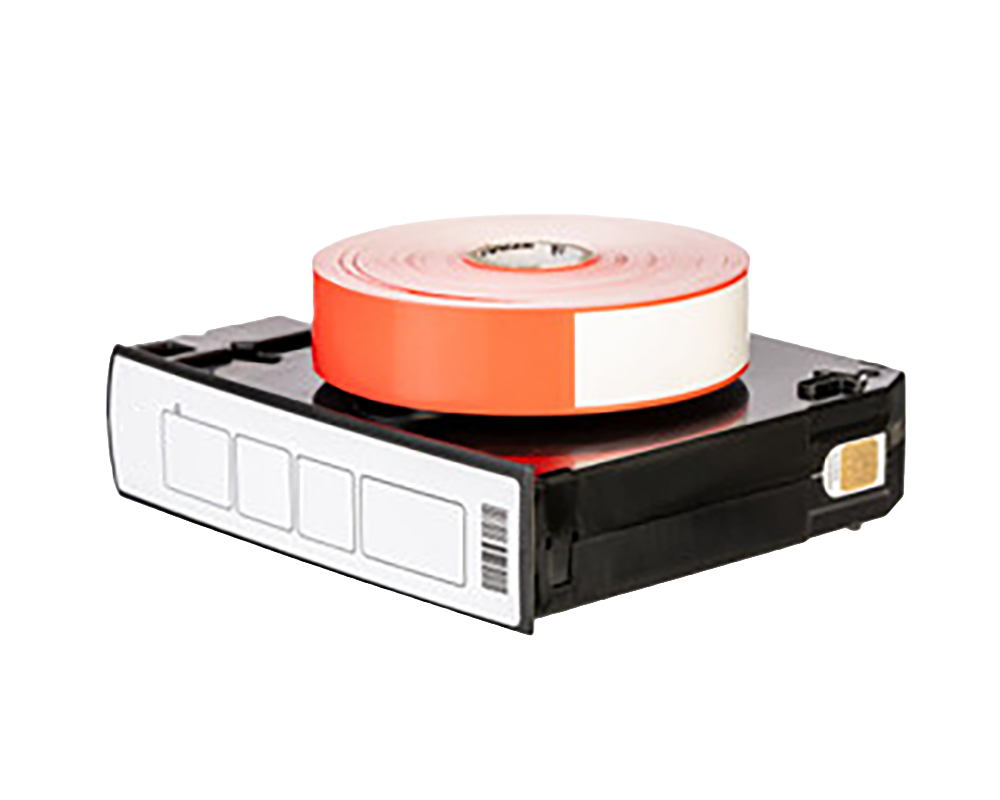
Color matters too. The 10006995K adult line ships in white plus red, blue, green, purple, pink, orange and yellow. Many inpatient units use color coding for acuity or isolation flags; check your facility’s wristband color policy before ordering mixed colors.
A practical tip: start with the white adhesive adult cartridge for pilot testing. It is the highest-volume SKU in the catalog and the easiest to validate.
Check 4 — Read the safety documentation, don’t skim the marketing line
This is where most supplier pages blur. Here is what the actual documentation supports for the referenced wristband line — and what it does not.
What is documented (sample batch: 25 × 279 mm thermal wristband):
- Six phthalates (DBP, DEHP, BBP, DINP, DNOP, DIDP) tested per EN 14372:2004 by GC-MS; none detected above the method detection limits (SGS Report NGBPC25000602201).
- Not made with natural rubber latex. SGS natural-latex identification (Report GZMR250200342401) identified the material as EVA/PP/PE, with no aqueous extractable protein detected at the 2 µg/mL detection limit.
- In-house tensile testing: withstood at least 7 kg of force per 15 mm of width without premature tearing under controlled conditions (internal testing — detailed test conditions available on request).
What these reports do not say, and what should not be inferred from them:
They do not mean the product is “medical grade,” “biocompatible,” or skin-safe certified. A patient identification wristband is a printing consumable / identification medium, not a medical device. Evaluate the documentation against your own procurement requirements, and ask the supplier for available test reports for your target market before bulk orders.
If a supplier claims antimicrobial, alcohol-resistant, or waterproof performance without showing you a test report, that is a documentation gap — not a marketing advantage.
Before you place the first bulk order
Three verification steps, in order:
- Request a paid sample. Run it on your actual printer. Not a bench test — a small live batch at the nurse station with the staff who will use it.
- Scan the printed barcode. Use the same 1D/2D scanners your ward uses. “The printer supports barcodes” is a setup claim, not a guarantee your existing scanners will read it.
- Check photo ID darkness and contrast on the same printer settings you will use in production.
If all three pass, the procurement math is straightforward:
- MOQ: 6 boxes
- Packaging: 6 cartridges per box; 4 boxes per export carton (24 cartridges per carton; carton size 17.5 × 14.5 × 5 cm, gross weight 13.92 kg)
- Shipping: international express (DHL, FedEx, UPS) for urgent needs; air freight for bulk replenishment; sea freight for large-volume shipments
Common mistakes to avoid
- Ordering by brand name instead of model. “Compatible with Zebra” means nothing unless HC100 or ZD510-HC is confirmed on both sides.
- Assuming compatible consumables void the warranty. Under the U.S. Magnuson–Moss Warranty Act, a manufacturer generally cannot void a printer warranty solely because a non-OEM consumable was used, unless the manufacturer demonstrates the consumable caused damage. This is general information, not legal advice; consult counsel for warranty-specific questions.
- Comparing only per-band price. Reprint rates, jam-related downtime, and emergency air shipments usually cost more than the unit-price difference. For illustration only: a facility printing 50,000 bands a month with even a 1% reprint rate loses 500 bands to wasted materials plus nurse-station labor time — which easily exceeds a modest per-band premium on a more consistent cartridge. Treat that as an example, not a quote; your own reprint data will be the real number.
Frequently asked questions
Are these wristbands compatible with all Zebra printers?
No. Confirmed compatibility covers the Zebra HC100 and ZD510-HC only. Confirm your printer model and media sensor setting before ordering; a paid sample lets you verify on your own machine.
Do these wristbands contain natural rubber latex?
The material was identified as EVA/PP/PE with no aqueous extractable protein detected at the 2 µg/mL detection limit (SGS Report GZMR250200342401). The product is not made with natural rubber latex.
Can we use loose wristband rolls instead of cartridges?
No. Both the HC100 and ZD510-HC require cartridge-format media with a black mark on the reverse side. A loose roll cannot be loaded, regardless of wristband dimensions.
What is the minimum order quantity?
MOQ is 6 boxes, packed 6 cartridges per box (24 cartridges per export carton). Smaller evaluation needs are covered by paid samples first.
Will using compatible wristbands affect our printer warranty?
Under the U.S. Magnuson–Moss Warranty Act, a warranty generally cannot be voided solely for using a non-OEM consumable unless damage is proven to be caused by it. This is general information, not legal advice.
Zebra® and Z-Band® are trademarks of Zebra Technologies Corp. IdPrintCare is an independent supplier and is not affiliated with, sponsored by, or endorsed by Zebra Technologies Corp.